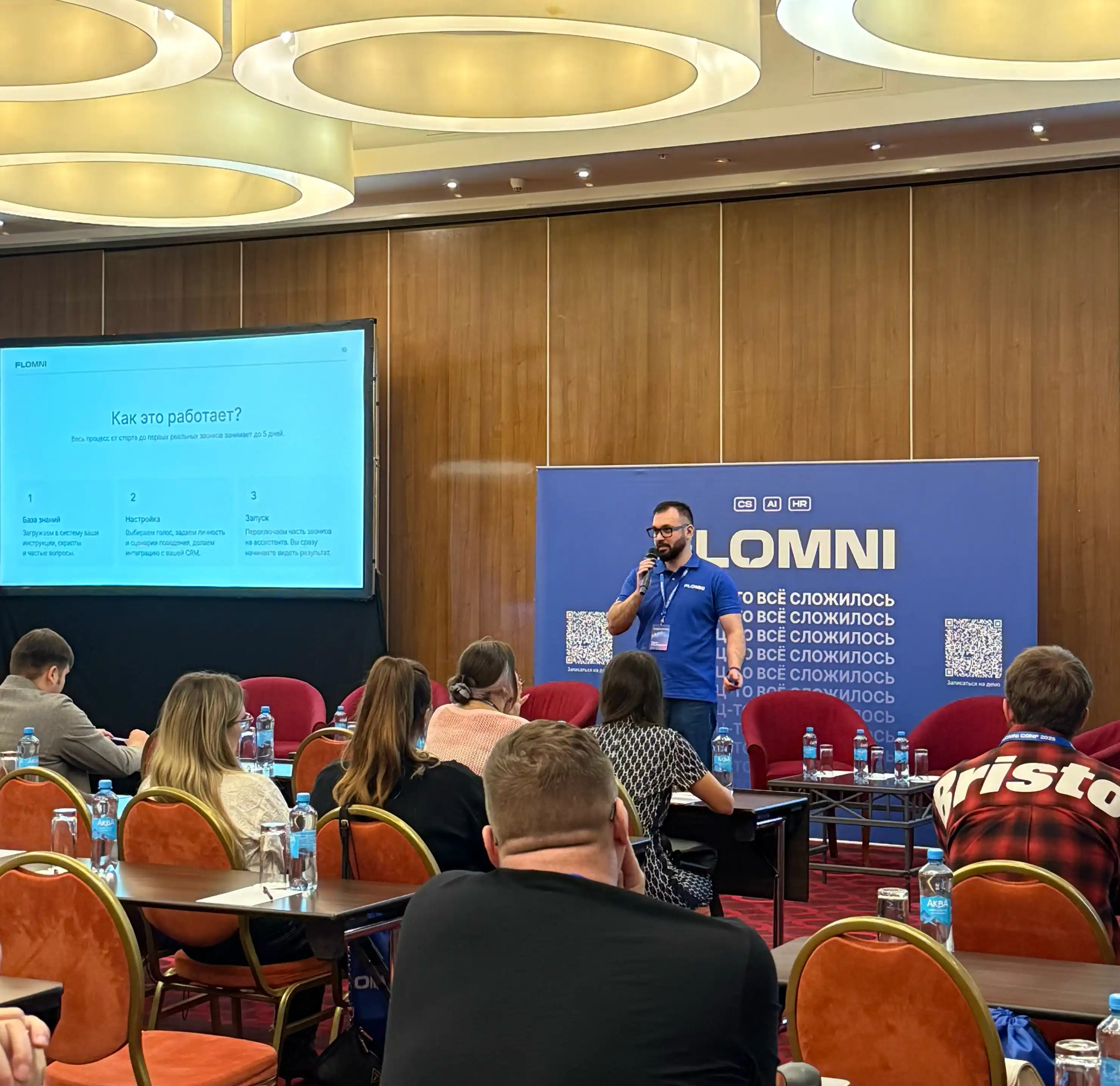
This past week, I had the opportunity to present at our first FlomniConf. My talk focused on a fundamental shift in how we should perceive customer conversations: not as a series of tasks to be completed, but as a rich stream of unstructured data—especially emotional and intentional data.
For years, voice automation has focused on understanding what a customer says. But the real competitive advantage lies in understanding how they feel and why they are calling. The traditional, "tone-deaf" bot is becoming obsolete.
To make this tangible, I ran a live demo showing our AI's "brain" in real time as it handled a call. On screen, the audience could see the live transcription of the dialogue, and next to it, a dashboard visualizing the AI's semantic analysis:
- Sentiment Analysis: The emotional tone of both the customer and the AI.
- Entity Extraction: The key pieces of data the AI was pulling from the conversation.
- Intent Recognition: What the customer was actually trying to achieve.
The demo scenario was simple: a customer calls with a problem, and their initial frustration is high. The audience saw the annoyance and distress metrics spike in real-time.
The "wow" moment wasn't just that the AI understood the words. It was that the AI, recognizing the negative sentiment, instantly adapted its strategy. It switched to a more empathetic tone, used validating language, and proactively offered a solution to de-escalate the situation. The audience then watched as the customer's sentiment graph shifted from "annoyance" to "satisfaction" and "relief".
The key takeaway is that the most advanced AI doesn't just process requests; it manages the emotional journey of the customer. This ability to understand and react to sentiment in real-time has a direct impact on customer satisfaction, reduces churn, and protects brand reputation.
Simultaneously, by extracting entities and intent, the AI turns a chaotic, emotional phone call into clean, structured data that can be used to improve business processes.
The future of customer interaction isn't just about faster responses; it's about smarter, more empathetic responses. The engagement after the talk confirmed that business leaders are ready to look beyond simple task automation and explore how AI can finally understand the human element of their customer relationships.